
Certification· 9 min read
CRCST vs CBSPD (CSPDT): Which Sterile Processing Certification?
CRCST (HSPA) or CSPDT (CBSPD)? Eligibility, exam, fees, test dates and renewal compared side by side, with sources, as of November 2026.
By CRCST Prep Editorial Team
Key takeaways
- The CRCST (from HSPA) and the CSPDT (from CBSPD) are separate, independent entry-level sterile processing technician certifications. Both are NCCA-accredited, and New York law accepts either.
- The biggest difference is eligibility: the CRCST needs 400 hands-on hours (before the exam or within 6 months after it), while the CSPDT accepts one of four routes, including a training course passed with a grade of 70 or higher.
- Scheduling differs too: the CRCST exam can be booked at a Prometric center within a 120-day window, while the CSPDT is offered in four one-week windows a year at PSI centers.
- Renewal differs: the CRCST renews every year (12 CE credits and $50), while the CSPDT lasts 5 years (100 points and $125).
The CRCST and the CSPDT are the two main entry-level certifications for sterile processing technicians, and they come from two independent bodies: HSPA (the Healthcare Sterile Processing Association) awards the CRCST, and CBSPD (the Certification Board for Sterile Processing and Distribution) awards the CSPDT. Both are national and NCCA-accredited, and many employers, and New York’s law, accept either. The choice usually comes down to how you qualify and when you can sit the exam.
- The CRCST fits if you work in, or can get into, a sterile processing department (SPD) to log 400 hands-on hours (before the exam, or within 6 months after it as a provisional), and you want to book a test date any time within 120 days of approval.
- The CSPDT fits if you qualify through one of CBSPD’s routes, such as finishing an SPD training course with a grade of 70 or higher or 12 months of SPD work, and you can test in one of four one-week windows a year.
- Either way, ask the employer you want to work for which one it prefers.
All figures below are as of November 2026, from HSPA’s Certification Handbook (revised January 2026) and CBSPD’s 2026 Technician Candidate Bulletin. Fees and rules change, so confirm on CBSPD’s technician page and HSPA’s CRCST page before you apply.
CRCST vs CSPDT at a glance
| CRCST (HSPA) | CSPDT (CBSPD) | |
|---|---|---|
| Awarded by | Healthcare Sterile Processing Association (HSPA), formerly IAHCSMM | Certification Board for Sterile Processing and Distribution, Inc. (CBSPD), Lebanon, NJ |
| Accreditation | ANSI National Accreditation Board (ANAB) and NCCA | NCCA (technician program); also the Navy COOL program |
| Eligibility | 400 hours of hands-on experience: full (before testing) or provisional (within 6 months after passing) | One of four routes: 12 months of SPD work; a training course passed with a grade of 70 or higher; 6 months each in allied health and in SPD; or 12 months of SPD-related product sales or service |
| Exam fee | $140 (includes a $25 non-refundable application fee) | $135 |
| Questions | 150 multiple choice (125 scored, 25 unscored pretest) | 150 multiple choice (125 scored, 25 unscored pretest) |
| Time | 3 hours | 3 hours |
| Where you test | Prometric testing centers | PSI Services testing centers |
| When you can test | Any time within 120 days after your application is approved | Four times a year, each in a one-week window |
| How passing is decided | Criterion-referenced pass or fail; HSPA publishes no percentage | A scaled score of 70 or above passes; see the scoring section |
| Retake | After 6 weeks, with the full fee | Register again with the full fee; not more than once per exam window |
| Certification length | 1 year, renewed annually | 5 years |
| Renewal | 12 continuing education (CE) credits a year plus $50 | 100 points over 5 years plus $125 |
| Exam sections | 7 | 8 |
| Course required? | No | No |
Who awards each certification
HSPA is a non-profit organization (its handbook says so) that was formerly known as IAHCSMM. CBSPD was founded in 1988 as the National Institute for the Certification of Healthcare Sterile Processing and Distribution Personnel and renamed in 2003. Neither is the “official” one: they certify independently, and both programs hold NCCA accreditation.
Eligibility: the biggest difference
CRCST. You need 400 hours of hands-on experience in a sterile processing department: 120 in decontamination, 120 in preparing and packaging, 120 in sterilization and disinfection, 24 in storage and distribution and 16 in quality assurance. Full certification means finishing the hours before you test. Provisional certification lets you take the exam first and finish the hours within 6 months after passing. Our CRCST certification guide covers both paths in detail.
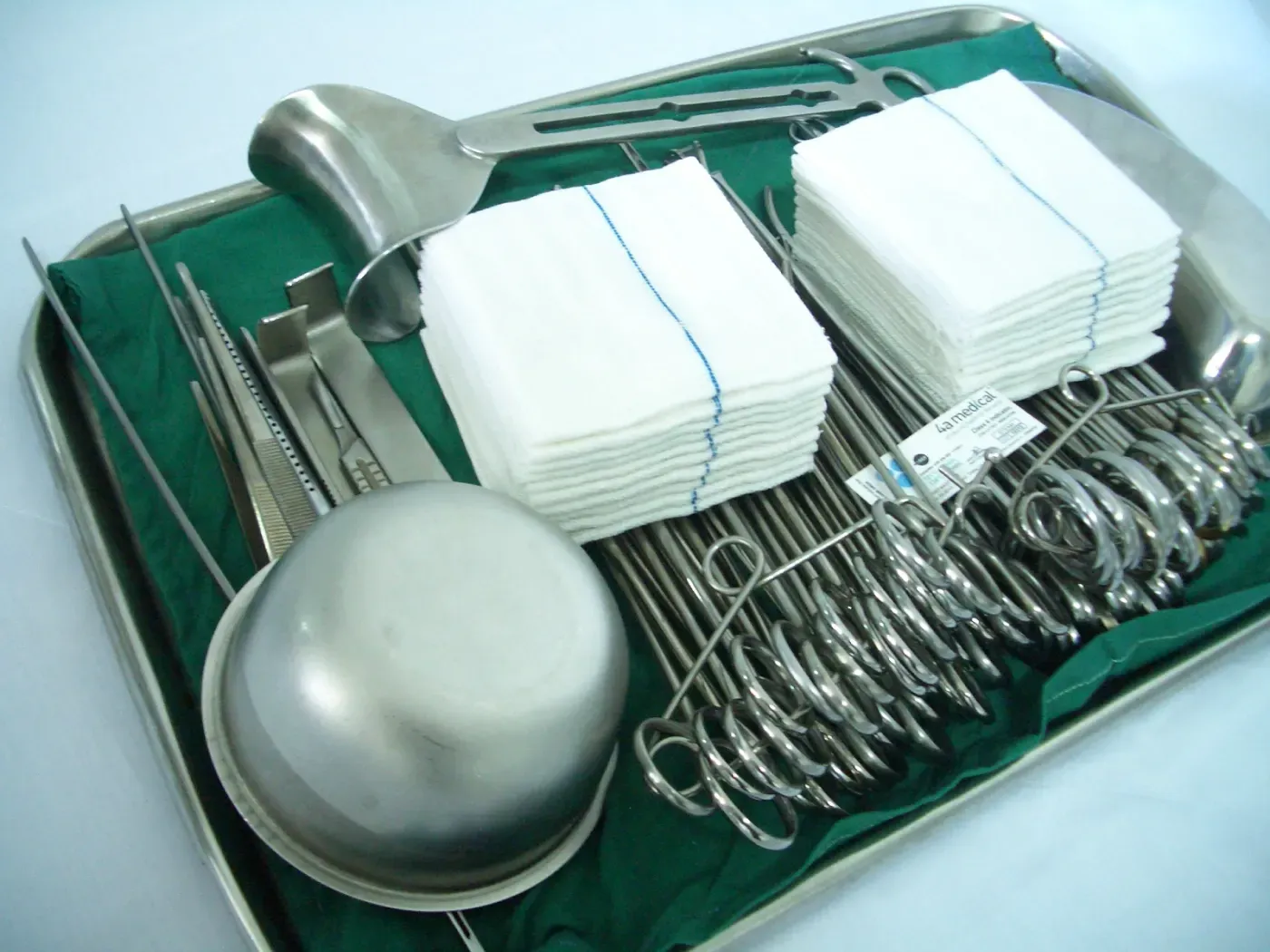 Photo: آرمین, via Wikimedia Commons (CC0).

CSPDT. CBSPD’s bulletin says you must meet one of these before the exam deadline:
- 12 months of full-time SPD employment, or the part-time equivalent, verified by your manager;
- an SPD training course passed with a grade of 70 or higher, with a copy of your certificate or grade;
- 6 months each of full-time work (or the equivalent) in a related allied health role and in SPD; or
- 12 months of healthcare product sales or service related to SPD.
In plain terms: a course graduate with no SPD hours can sit the CSPDT. For the CRCST, that graduate can test as a provisional but must then finish 400 hours within 6 months.
The exams compared
The two exams have the same shape: 150 multiple-choice questions, 125 of them scored, in 3 hours. The sections differ, and the overlap is large. The core work of decontamination, preparation and packaging, sterilization and storage is on both.
| HSPA CRCST (7 sections) | Weight | CBSPD CSPDT (8 sections) | Weight |
|---|---|---|---|
| Departmental Considerations | 15% | Roles and Responsibilities | 13% |
| Cleaning, Decontamination and Disinfection | 21% | Life Science | 9% |
| Preparation and Packaging | 21% | Decontamination and Disinfection | 19% |
| Sterilization Process | 21% | Preparation and Handling | 16% |
| Sterile Storage, Transport and Inventory Management | 9% | Sterilization | 18% |
| Patient Care Equipment and Distribution | 5% | Sterile Storage, Inventory Management and Distribution | 11% |
| Professional Development and Human Relation Skills | 8% | Patient Care Equipment | 6% |
| Ethics | 8% |
CBSPD has separate Life Science and Ethics sections. HSPA folds related topics into Departmental Considerations and Professional Development. The exams are written from different outlines, so a study plan built for one isn’t built for the other.
Scheduling and test centers
CRCST: once HSPA approves your application, you have 120 days to schedule and take the exam at a Prometric testing center. Miss that window and you forfeit your fee.
CSPDT: the exam is given four times a year within a one-week window, on computer at PSI Services testing centers. CBSPD’s dates page lists the 2027 windows and application deadlines: February 1 to 6 (deadline January 26), May 3 to 8 (April 27), August 2 to 7 (July 27) and November 1 to 6, 2027 (October 26), as of November 2026. If you need the credential by a hire deadline, that schedule matters more than the fee.
How each exam is scored
HSPA uses a criterion-referenced standard. Pass or fail depends on how many scored questions you answer correctly, and the handbook says HSPA “does not provide percentage scores”. Your result report rates each section as “At or Above”, “Below” or “Well Below”.
CBSPD converts your raw score to a scale. Its bulletin says a scaled score of 70 or above is reported as a pass, and passing candidates get no numeric score, only a pass. A scaled 70 is not “70% correct.” Each test form has its own raw-to-scale conversion, and the bulletin explains that the easier the questions, the more you must answer correctly to reach a given scaled score. CBSPD gives an official pass or fail at the end of the exam for US candidates, and certificates are mailed within 6 weeks of the end of the exam window.
Neither number tells a CRCST candidate what percentage to aim for. Our CRCST study guide explains how to judge readiness without one.
Cost and renewal over five years
Fees only, at November 2026 prices, counting from the exam through the renewal due at year 5:
| CRCST | CSPDT | |
|---|---|---|
| Exam fee | $140 | $135 |
| Renewals through year 5 | $50 a year × 5 = $250 | One $125 renewal at year 5 |
| Total fees | $390 | $260 |
| Continuing education | 12 CE credits a year, 60 in total | 100 points over the 5 years |
CE costs vary, and many credits are free. A retake costs the full exam fee for either exam. If a CSPDT certification lapses, CBSPD’s bulletin says you must retake the exam to recertify.
Which one do employers ask for?
Only one rule can be cited here. New York’s Public Health Law § 2824 accepts the certified registered central service technician credential, the certified sterile processing and distribution technician credential or a substantially equivalent credential, and gives new hires 18 months from the date of hire to obtain one. Beyond that, check job postings and ask your manager or the hiring department, because requirements vary by employer and state.
Can you hold both?
Yes. Nothing in either body’s materials stops you from holding both, since each certifies independently. Keep in mind that you would pay both sets of renewal fees and meet both sets of continuing education requirements.
Preparing for the CRCST
If you choose the CRCST, our free CRCST practice tests include a mixed test and one test per HSPA section, and our 8-week study plan shows how to use them. The CRCST Prep app has 901 exam-style questions with explanations, timed 150-question mock exams (part of the Pro subscription) and flashcards on iPhone and iPad. Still logging hours? See how to become a sterile processing technician.
Our materials are written for HSPA’s CRCST outline. If you choose the CSPDT, use CBSPD’s own outline and its Technician Study Guide.
 Photo: آرمین, via Wikimedia Commons (CC0).

Frequently asked questions
Is the CRCST or CBSPD better?
Neither is better in general. Both are NCCA-accredited and accepted by New York law, so the choice depends on how you qualify, when you can test and what your employer prefers.
What is the difference between CRCST and CSPDT?
The CRCST is from HSPA and the CSPDT is from CBSPD. They differ in eligibility (400 hands-on hours vs one of four routes), scheduling (a 120-day window vs four one-week windows a year) and renewal (every year vs every 5 years).
Can I take the CBSPD exam without experience?
Yes, if you have completed an SPD training course with a passing grade of 70 or higher and attach your certificate or grade. The other three routes need work or sales experience.
How much does the CBSPD exam cost?
$135, according to CBSPD’s 2026 Technician Candidate Bulletin and its technician page, as of November 2026.
How long is the CSPDT valid?
5 years. Recertification takes 100 points over the 5 years and a $125 fee.
Does New York accept the CBSPD?
Yes. New York Public Health Law § 2824 names both the CRCST and the CSPDT credentials.
Can I have both CRCST and CSPDT?
Yes, since each body certifies independently. You would renew each one separately.
Sources
Checked on November 16, 2026 (CBSPD 2026 Technician Candidate Bulletin; HSPA Certification Handbook, revised January 2026). Fees and rules change, so confirm with each organization.
- CBSPD: Technician certification
- CBSPD: 2026 Technician Candidate Bulletin (PDF)
- CBSPD: Exam dates and test sites
- HSPA: Certified Registered Central Service Technician (CRCST)
- HSPA: Certification Handbook, revised January 2026 (PDF)
- New York Public Health Law § 2824: Central service technicians
CRCST Prep is an independent study tool and is not affiliated with, sponsored or endorsed by HSPA or CBSPD. CRCST is HSPA’s certification; CSPDT is CBSPD’s certification.
Written by
CRCST Prep Editorial Team
The team behind CRCST Prep, the CRCST exam prep app. Questions or corrections? Contact us.